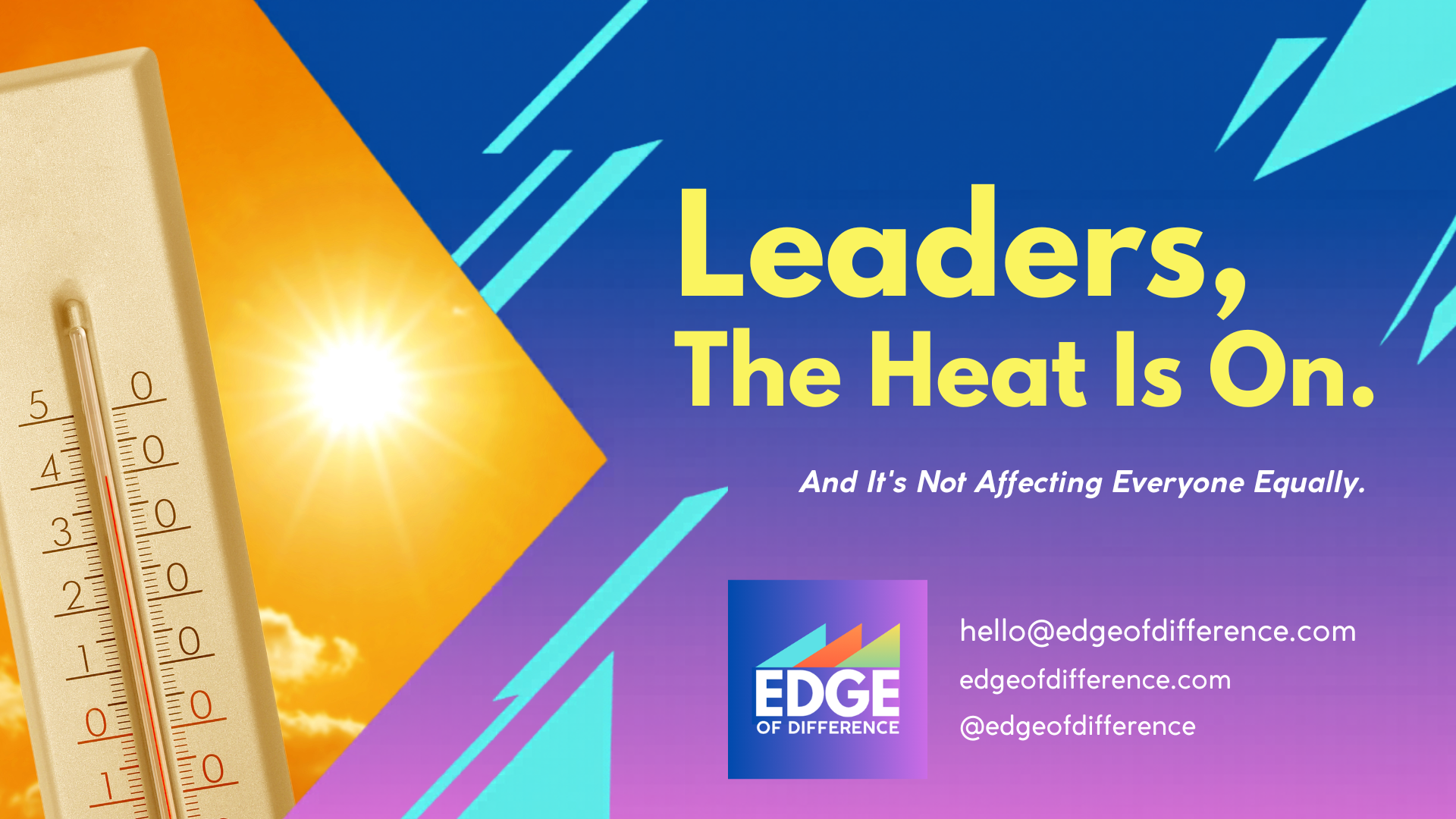
And It’s Not Affecting Everyone Equally.
Every summer, the UK swelters through another heatwave, and every summer, workplaces scramble to cope. Fans dragged out of storage. Dress codes relaxed. Someone sends a chirpy all-staff email about staying hydrated.
And then we move on.
But here’s what that cheerful response misses: rising temperatures are not a neutral inconvenience. They are a diversity, equity and inclusion issue. And the organisations that don’t see it that way are already failing a significant proportion of their workforce.
Let us explain why.
The law gives employers wiggle room they should not be taking
There is currently no legal maximum workplace temperature in the UK. Employers are required to keep temperatures “reasonable.” The TUC has called for a maximum indoor working temperature of 30°C, or 27°C for physically demanding work, and has also proposed that employers should be required to take action once temperatures exceed 24°C and staff begin reporting discomfort. Those proposals have not yet become law.
That gap between legal minimum and genuinely safe is where workers suffer.
And not all workers suffer equally.
Who bears the heat?
Think about who is most exposed when temperatures rise. Those at greater risk include the elderly, pregnant women, menopausal women, and people with underlying conditions such as diabetes or heart disease. Add to that anyone working outdoors, in warehouses, in kitchens, in construction, in social care, in roles that are disproportionately held by people from lower income backgrounds, people of colour, and people with disabilities.
This is a health equity issue at its core. If you can afford air conditioning and work indoors, you can generally insulate yourself from extreme heat. But lower-income populations and especially outdoor workers have little escape, finding themselves at the mercy of temperatures where even moderate physical exertion is lethal.
Globally, the picture is stark. Extreme heat deepens environmental injustice, disproportionately affecting workers who often live in hotter areas with fewer cooling resources and limited access to healthcare. Farmworkers and those in precarious employment are particularly vulnerable, often working in extreme heat with little ability to demand protections.
This is not a faraway problem. In the UK, it plays out along the same fault lines of privilege. The person who can close their laptop and work from a cool home has options the warehouse worker, the care worker, and the outdoor contractor simply do not have.
The Equality Act already applies. Are you using it?
Here is something many employers don’t realise, or choose not to act on: under the Equality Act 2010, employers must consider how heat interacts with specific health needs. Reasonable adjustments may be required for pregnancy and disability, because heat can worsen certain conditions and increase risk.
That means this is not just a health and safety matter sitting in a separate silo. It connects directly to your inclusion obligations. If you are not reviewing your heat policies through an equity lens, you are potentially in breach of those obligations, and you are certainly not meeting the spirit of them.
What good leadership looks like when temperatures rise
Practical action does not have to be complicated. It does have to be intentional, and it has to account for who in your workforce is most at risk.
Equity UK, the performing arts trade union, has been a vocal voice on this, running their “Too Hot to Work” campaign to push for clearer protections for workers in theatres, outdoor venues, and performance spaces where cooling infrastructure is often entirely absent. Their work matters beyond the arts sector, because the question they are asking is the right one for every industry: at what point does the heat become a reason to stop, not just to carry on with a bottle of water?
Here is what organisations should be doing right now:
Conduct a heat risk assessment that is also an equity audit. Who in your workforce is most exposed? What roles are they in? What protected characteristics do they hold? Do your standard heatwave policies reach them?
Make flexible working a genuine option, not a perk for the privileged few. If some of your workforce can work from home or adjust their hours during a heatwave and others cannot, that gap is an inclusion failure. Close it where you can. Where you cannot, compensate with breaks, rest space, and adjusted duties.
Take menopausal and pregnant employees seriously. Practical adjustments include more frequent rest breaks, access to cooler rooms, and temporary changes to duties that reduce exertion. These are not optional extras. They are inclusion in practice.
Stop treating “reasonable” as the goal. The legal bar in the UK is low. Your inclusion ambition should be higher. Reasonable is the floor, not the ceiling.
Give workers a genuine voice. If someone tells you they are too hot to work safely, that is not a complaint to be managed. It is information to be acted on. Organisations that prioritise employee wellbeing are likely to see benefits not only in compliance but also in productivity, engagement and staff retention. The reverse is also true.
And on the bigger picture
The Greenpeace Make Polluters Pay campaign is a reminder that individual organisations do not exist outside the systemic context that is producing these heatwaves in the first place. Climate justice and workplace equity are connected. The people least responsible for the carbon emissions driving extreme heat are, consistently, the people most harmed by it. That is not incidental. It is structural.
Leaders who take inclusion seriously cannot afford to treat the climate crisis as someone else’s issue. The decisions you make about how you protect your workforce when temperatures rise are inclusion decisions.
The heat is not coming. It is here.
Summer 2026 will not be the last summer we have this conversation. The question is whether your organisation is still sending the all-staff hydration email, or whether you are actually doing the work.
There are 10 practical steps to take to further support employees working in the heat; read them here: https://www.equity.org.uk/advice-and-support/health-and-safety/working-in-a-heatwave-high-temperatures-andor-direct-sunlight
Want to think through what an equity-led approach to workplace wellbeing looks like in your organisation? Get inclusion ready with us today by committing to our Inclusion Power-Up package.