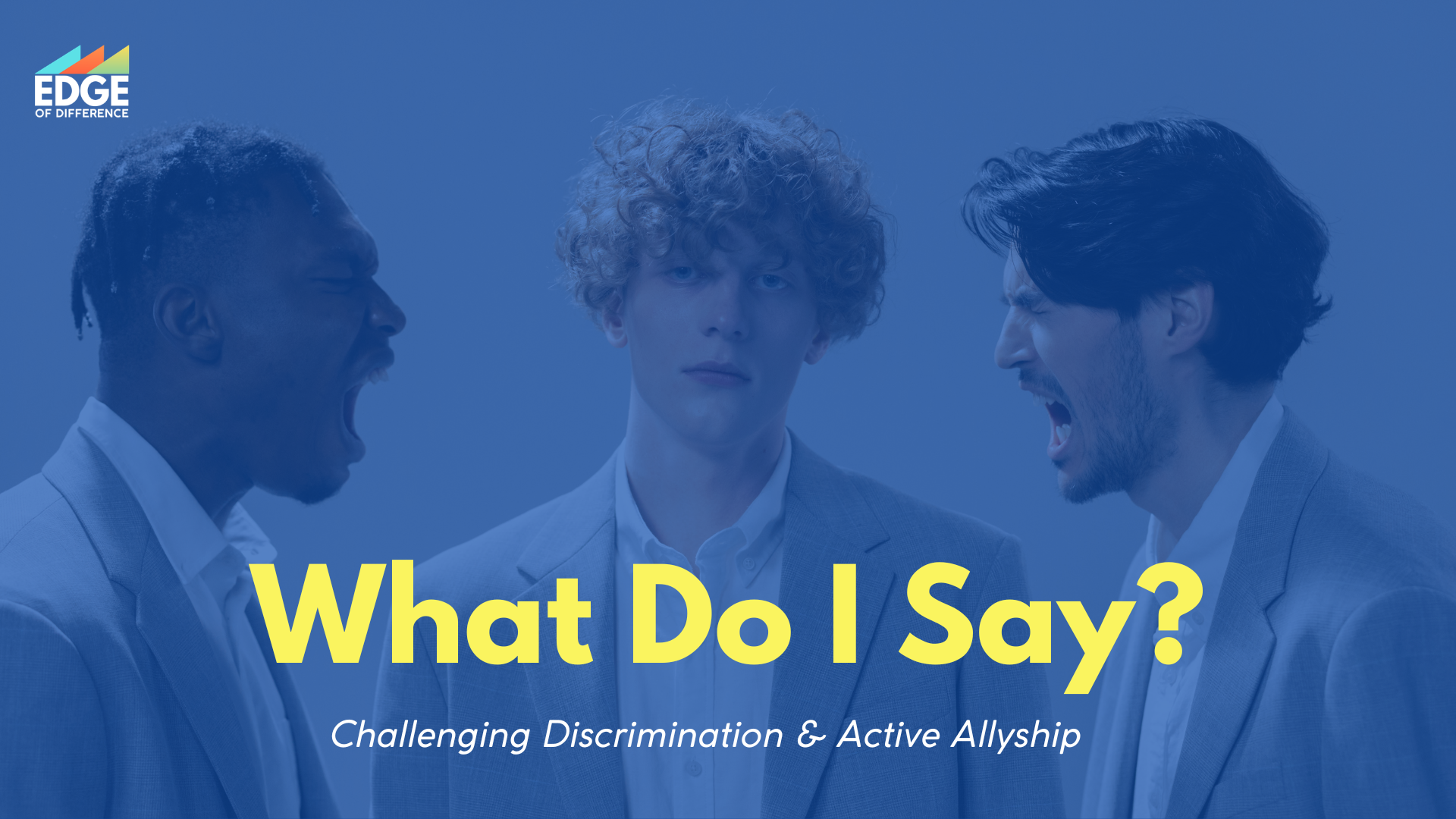
You see it happen. A comment, a joke, a dismissive remark aimed at someone in the room. You know it’s not OK. And then the moment passes, because you didn’t know what to say.
This happens more than we’d like to admit. In fact, 66% of people feel stressed or anxious about having difficult conversations. Challenging discrimination isn’t a personality trait some people are born with and others aren’t. It’s a skill, and like any skill, it can be learned.
Why bother?
It’s easier not to, if you have the choice. But that’s injustice and privilege at its very core. The whole point is that there shouldn’t be a choice.
Allyship is a verb, not a noun.
When we call people out, we’re not trying to take up space for ourselves or “cancel” anyone. Cancel culture, like “political correctness”, focuses on not offending and avoiding discomfort, which actually stops people from engaging at all. The goal is different. We should be using our power and influence to help people, and addressing injustices with an understanding that their origins and impacts go far beyond the personal.
What actually makes this hard?
Misunderstandings. Perceptions. Bias. These are the things that get in the way of a conversation before it’s even started.
And when you’re the one being held accountable, it can feel even harder. It’s natural to feel defensive. The work is in recognising that reaction, taking a breath, and looking for the learning opportunity instead of digging in. Reframing this as a chance to grow, rather than an attack, is the secret that makes accountability possible at all.
So, what do you actually say?
This is the question we get asked most often, and it’s the reason we built this resource.
Inside, you’ll find starting phrases for different situations, from the short and direct (“What do you mean by that?”) to language for setting boundaries, encouraging someone to do their own research, and reinforcing a person’s humanity while still naming the impact of what they said.
Picture this. Someone cracks a “joke” in a team meeting, the kind that leans on a stereotype and gets a few uncomfortable laughs. It’s not a slip of the tongue. It’s a microassault, a deliberate dig dressed up as humour so it’s harder to challenge without being called “too sensitive.”
This is exactly where the short and direct phrase earns its place. “What do you mean by that?” does more work than people think. It doesn’t accuse, but it doesn’t let the comment slide past either. It puts the weight of explaining the joke back on the person who made it, and most discriminatory humour doesn’t survive being explained out loud.
You’ll also find our 4-D framework, a structure for thinking through how to respond in the moment. Sometimes the right move is to challenge a behaviour directly. Sometimes it’s safer to delay, distract, or delegate to someone else with more standing in the room. None of these are lesser options. They’re tools, and knowing which one fits the moment is part of the skill.
Get the resource
If you’ve ever left a room wishing you’d said something, this one’s for you.
At Edge of Difference, we work with organisations ready to close the gap between the culture they believe they have and the one their people are actually experiencing. If this piece landed somewhere real for you, book a conversation with us and put these words into practice.