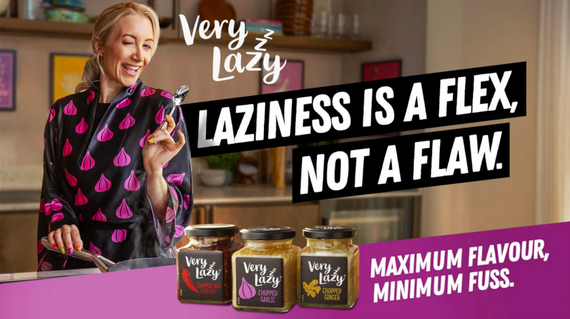
We spotted a billboard recently that stopped me mid-scroll. Bold white letters on a black background: “Laziness is a flex, not a flaw.” It was an ad for Very Lazy, a brand selling jars of pre-chopped garlic, ginger and chilli.
The tagline? Maximum flavour, minimum fuss.
Our first reaction was a grin. Our second was: that’s a blog right there.
However, here’s the thing. When we design something to remove friction, to make it easier, quicker, less physically demanding, we almost always call it one of two things depending on who we think it’s for.
If it’s for a disabled person? We call it accessibility.
If it’s for everyone else? We call it convenience, innovation, or apparently…a flex.
Additionally, what if those two things are actually the same thing, if the most “convenient” tools in your working day were born from the disabled community’s need to simply be included?
Spoiler: in short, they were.
The Curb Cut Effect: In Your Office, Your Laptop, Your Commute
There’s a principle in inclusive design called the Curb Cut Effect. The sloping ramps between the footpath and street were originally designed for wheelchair users, but it was quickly identified they also benefit parents with strollers, travellers with luggage, and couriers with trolleys. Moreover, design for the margins, and you end up designing for everyone.
This isn’t a feel-good footnote. Therefore, it is how the modern world was built. Your working day is full of proof.
10 Everyday Work Tools Invented from Accessibility Needs
1. The keyboard (yes, that keyboard)
Every email you’ve ever sent, every document you’ve ever written. The modern typewriter and the QWERTY keyboard we still use today was invented by Italian Pellegrino Turri as a way to help his blind partner communicate in writing. Without that need to solve an accessibility barrier, you might be dictating everything to a scribe right now.
2. Audiobooks
Think Audible is a commuter luxury? The American Foundation for the Blind began creating recordings of books on vinyl records in 1932, originally so people with visual impairments could access literature. People driving, exercising, learning languages, or simply preferring to listen have made audiobooks a staple of everyday life.
3. Closed captions
If you’ve ever watched a training video on mute at your desk, on a noisy train, or in a hotel with forgotten headphones, you’ve benefited from this one. Closed captions were developed to support users who are deaf or hard of hearing, but are now widely used by people learning a second language, viewers in noisy environments, and anyone who prefers to watch video without sound.
4. Voice recognition and speech-to-text
Dictating your notes, asking Siri to set a reminder, using voice search. One of the original driving forces behind speech-to-text technology was to give people who couldn’t physically write access to getting their thoughts down “on paper.” Subsequently, it’s vastly on the majority of phones, in military aircraft, car navigation systems, and home automation.
5. Automatic doors
In the 1970s, the first automatic access doors for people with mobility disabilities were built. By the 1990s, automatic doors with motion detectors had become widespread and can now be found everywhere, from schools and supermarkets to stadiums. Consequently, you walk through them every day without a second thought.
6. The electric toothbrush
The Broxodent electric toothbrush was invented in 1954 for people with limited mobility and strength who needed help with brushing. Later, dentists recommend them widely as a superior tooth-cleaning device. Designed for access. Eventually, adopted by everyone with teeth.
7. OXO Good Grips kitchen tools
The ergonomic, wide-handled kitchen tools used in offices, homes and restaurants everywhere. Inventor Sam Farber created the OXO Good Grips range after watching his wife, who had arthritis, struggle to use a potato peeler. The soft rubber grip, easy to hold with limited hand strength, became so popular that many other brands have since copied the design.
8. The bendy straw
Hospitals designed the bendable straw so bedridden patients could drink while lying down, and its practicality made it universal. You’ve probably used one at a birthday party, a restaurant, or handed one to a child. Undeniably, it came from a need for physical access.
9. Dyslexie Font and readable design
Christian Boer, who has dyslexia, designed the Dyslexie Font in 2008 out of his own frustration with reading errors. Clear, readable typography designed for neurodivergent readers is now considered best practice in communications design because it works better for everyone, including people reading in a second language or under stress.
10. Text messaging (SMS)
Fewer people know this origin story. Deaf communities invented real-time text communication in the 1960s. Then, the rest of us called it SMS and acted like we’d thought of it ourselves.
The Leadership Lesson?
Here it is, plainly: every time we exclude, we impoverish everyone.
When we design meetings, communications, processes, and workplaces only for the perceived “default” employee, we don’t just fail disabled colleagues. We build organisations that are less creative, less resilient, and less human.
The Very Lazy billboard made us laugh because it accidentally told the truth. What we frame as convenience for the mainstream (flexibility, reduced friction, multiple formats, easier tools) is what disabled people have been asking for as basic access for decades.
When an employee asks for a written summary of a meeting, that’s not laziness. That might be a dyslexic colleague processing information in the way that works for them and every other team member who didn’t take notes.
When someone needs a quiet room, a later start, or captions on a video call, that’s not a special request. That’s good design. In fact, design that, as history shows us, will end up benefiting everyone in the room.
The Question We Should Be Asking
Not “why does this person need special treatment?”
But “why didn’t we design it this way in the first place?”
The curb cut didn’t just help wheelchair users. Henceforth, it helped the city function better. Your keyboard didn’t just help a blind Italian countess write letters in 1608. It helped build the entire modern economy.
What could you unlock in your organisation, right now, by designing for the person you assumed was the exception?
That’s not laziness. That’s leadership.
Read more everyday items derived from accessibility advancements here: https://reciteme.com/news/accessibility-inventions-in-everyday-items/
Want to talk about inclusive, universal design in your workplace? Get in touch.
Download our resource on “Universal Design” to take action for you, and your workforce.