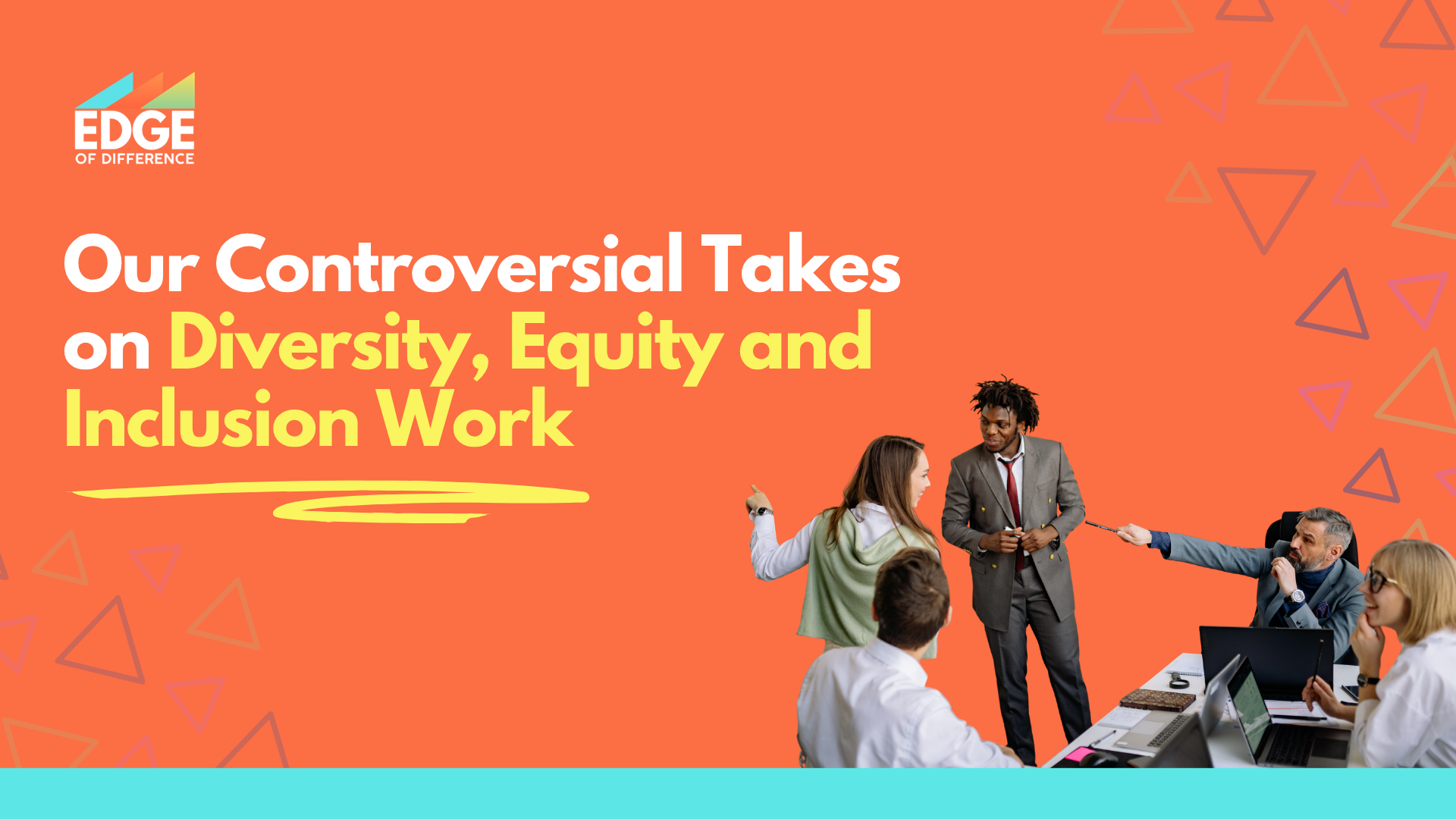
Diversity, Equity and Inclusion (DEI) is having a moment. And not always a good one.
Depending on who you listen to, it’s either the most important work organisations can do right now or an ideological project that’s dividing workplaces, undermining merit, and threatening the bottom line.
The debate is loud, it’s political, and it’s increasingly exhausting for the people who’ve spent years doing the work with care and rigour.
But loud doesn’t mean right.
This blog takes five of the most common criticisms levelled at DEI and looks at what’s actually behind them, the kernel of truth where it exists, and the sleight of hand where it doesn’t.
Because if we’re going to have this conversation, let’s have it honestly.
Reverse Discrimination Is Not Caused By Diversity, Equity and Inclusion Work – When It’s Done Well:
Let’s talk about a phrase that gets thrown around a lot when DEI comes up: reverse discrimination. And specifically, why it doesn’t hold up.
First, a distinction worth making. Positive action is real. It’s the deliberate effort to open doors for people who’ve historically had them closed; adjusting hiring processes, widening access, tackling the bias we know exists. And we do know it exists. Studies consistently show that identical CVs get treated differently depending on the name at the top. Positive action is a response to that reality. It’s not charity. it’s a correction.
Reverse discrimination, on the other hand, isn’t a legal term or a sociological concept. It’s a rhetorical one. The idea is that efforts to include people who’ve been excluded must, by definition, be excluding someone else. But that logic only works if you assume everyone started from the same place…and they didn’t.
If someone from a majority group misses out on an opportunity in a process designed to be more inclusive, that’s frustrating. But frustration isn’t the same as systemic disadvantage. Those aren’t equivalent experiences, even if they feel similar in the moment.
The same thinking applies to the concept of reverse racism. Prejudice (the belief that someone is lesser because of their background) can come from anyone. But racism isn’t just individual prejudice. It’s prejudice that’s been baked into systems, institutions, and structures over centuries. You can’t simply flip it around and have the same thing in reverse, because the historical and structural context is completely different.
And on quotas, most DEI work isn’t actually about rigid quotas. What it’s really trying to do is dismantle the invisible quotas that already exist: the unspoken assumptions about who “fits”, the “culture fit” gatekeeping that often just means “reminds us of ourselves”, the reliance on unpaid internships or prestigious universities that screen out talented people before they even get a look in. Adjusting a process so qualified people aren’t filtered out before anyone sees them isn’t marginalising the majority, it’s widening what we recognise as talent.
Here’s the simplest way to think about it. Equity isn’t about giving some people more than others. It’s about recognising that the playing field was never level, and doing something about it. Equal treatment sounds fair, give everyone the same ladder, right? But if the wall is a different height for different people, the same ladder doesn’t get everyone over. That’s what equity is trying to fix.
“Reverse discrimination” is often how it feels when a system that quietly benefited you starts to change. That feeling is worth acknowledging but it shouldn’t be confused with injustice.
Meritocracy Is A Myth, And Workplace Diversity, Equity And Inclusion Initiatives Question It’s Validity:
Meritocracy is one of those ideas that sounds completely reasonable…until you look at how it actually works in practice.
The argument goes: hire and promote the best person for the job, full stop. No quotas, no targets, no demographic considerations. Just pure, objective talent. It’s a compelling idea. The problem is that it assumes something that simply isn’t true, that we’re all being assessed on a level playing field, by unbiased people, using neutral systems. And we’re not.
Workplaces don’t exist in a vacuum. They’re part of the same world that under-funds schools in poorer areas, that rewards confidence over competence, that associates leadership with a very particular, and very narrow, set of traits. The “best person for the job” doesn’t get evaluated in some pristine, context-free environment. They get evaluated by humans, shaped by the same cultural assumptions the rest of us carry.
We know this because the research tells us so. CVs with white-sounding names get more callbacks than identical CVs with ethnic-sounding names. We know that women are assessed on performance while men are often assessed on potential. We know that people who went to the “right” schools, who speak in the “right” accent, who socialise in the “right” circles, move through organisations more smoothly, not because they’re more talented, but because the system was built around people who look and sound like them.
That’s not meritocracy. That’s familiarity dressed up as merit.
Here’s the real question: if meritocracy were genuinely operating in our workplaces, why would leadership teams be so demographically homogenous? Are we really to believe that talent, ambition, and capability cluster so neatly along lines of gender, race, class, and disability? Or is it more likely that our definition of “merit” has quietly absorbed a whole set of assumptions about who a leader looks like?
DEI work isn’t the enemy of meritocracy. It’s actually trying to rescue it. Removing bias from recruitment processes, widening the talent pool, questioning whether “culture fit” is doing the work of genuine assessment or just reproducing the same type of person; all of that is in service of finding the best people, not despite it.
The critique that DEI prioritises demographic characteristics over talent misunderstands what’s happening. It’s not “this person is less qualified but ticks a box.” It’s “this person is equally or more qualified, but the system was likely to filter them out before anyone noticed.” Fixing that isn’t lowering the bar. It’s making sure the bar is applied consistently, to everyone.
True meritocracy, the version where the best really do rise regardless of background, is actually a DEI goal. We’re just honest about the fact that we’re not there yet, and that getting there takes deliberate effort.
Because doing nothing and calling it fairness? That’s not meritocracy either. That’s just the status quo with better PR.
Good Business Is Inclusive Business – The Real Shareholder Risk Is A Boardroom That All Thinks the Same:
Let’s start with the misuse of the phrase “woke”, because it’s doing a lot of work in this argument, and not very honestly.
The suggestion is that caring about people, about whether your workplace is fair, inclusive, and psychologically safe is somehow in tension with running a successful business. That social goals and commercial goals are pulling in opposite directions, and that smart businesses should stay firmly on the commercial side.
But that framing falls apart pretty quickly when you look at what the evidence actually says.
Diverse teams consistently outperform homogenous ones. McKinsey has been tracking this for over a decade. Companies in the top quartile for ethnic diversity are significantly more likely to outperform financially. Gender-diverse leadership teams show similar patterns. This isn’t activism. It’’s key business data. Different perspectives, different lived experiences, different ways of approaching a problem, these things produce better thinking, better decisions, and better products. Especially in complex, fast-moving markets where groupthink is genuinely dangerous.
Then there’s the talent argument. We are in a period where skilled people, particularly younger workers, are actively choosing employers based on values, culture, and a sense of belonging. If your workplace isn’t psychologically safe, if people from different backgrounds don’t feel like they can thrive there, you will lose talent to organisations that have figured this out. Recruitment and retention are expensive. Belonging isn’t a nice-to-have, it sets you and your business up for a competitive advantage.
And here’s the question worth sitting with: if your workplace isn’t equitable, who exactly is thriving there? Because a workplace that only works well for a narrow slice of people isn’t a high-performing workplace, it’s a comfortable one for the people it was built around. Those aren’t the same thing.
Psychological safety, the ability for people to speak up, challenge ideas, flag problems without fear, is one of the strongest predictors of team performance we have. Google’s Project Aristotle, one of the most extensive studies of team effectiveness ever conducted, put it at the top of the list. And psychological safety isn’t evenly distributed in most organisations. It tends to be highest for people who already feel like they belong, and lowest for those who’ve learned (often through experience) that speaking up carries a different kind of risk for them.
DEI work directly addresses that. It’s not a distraction from performance, it is performance work at it’s finest!
The “shareholder value” critique also assumes a very short-term, very narrow definition of value. Shareholders and the institutional investors increasingly influencing corporate governance are paying close attention to ESG (environmental, social and governance) metrics. Reputational risk, legal risk, the cost of high turnover, the innovation deficit that comes from a monoculture, these all hit the bottom line. Just sometimes with a delay that makes it easy to ignore until it’s too late.
So the real question isn’t whether DEI is a business goal. It’s whether you can genuinely claim to be a well-run, forward-thinking, high-performing organisation while ignoring whether the people inside it have equal access to opportunity, safety, and growth.
If your answer to that is “yes”: it might be worth asking who gets to feel that way, and who doesn’t.
Because building a workplace where different people can genuinely thrive and progress isn’t a compromise on performance. It’s what performance actually looks like when you zoom out far enough to see the whole picture.
Diversity, Equity and Inclusion Calls You In To Reflect, Not Shames Employees
Let’s call this what it actually is.
When people accuse Diversity, Equity and Inclusion of shaming employees, listen carefully. They’re not describing an attack. They’re describing the moment someone challenged their assumptions for the very first time.
for the first time, to consider how systems of power and privilege operate, and where they sit within them. That’s not shame. That’s challenge. And those two things are very different.
Discomfort is not the same as attack.
Feeling unsettled when you examine assumptions you’ve never questioned before? That’s human. It doesn’t mean the facilitator got it wrong, the session missed the mark, or DEI creates division. It means something hit home. That’s not a problem. That’s progress.
Here’s a useful way to think about it. If you’ve never had to think about your accent, your name, your postcode, or your appearance when walking into a room, that invisibility is itself a form of privilege. When you notice that for the first time, it can knock you off balance. But the people who have had to think about those things, every single day, haven’t had the luxury of feeling comfortable. So when we talk about fragility in DEI spaces, we’re really talking about the friction of catching up with a reality that other people have been living all along.
That friction? It’s actually a sign the work is reaching people. A DEI session where everyone leaves feeling completely fine and entirely unchallenged probably hasn’t moved anything. Growth, real growth, the kind that changes behaviour and not just awareness tends to feel uncomfortable before it feels liberating. That’s not unique to DEI. It’s true of any meaningful learning.
Now, the “oppressor and oppressed” framing, that’s worth taking seriously, because bad DEI delivery does exist. Reducing people to fixed categories, assigning collective guilt, leaving no space for nuance or individual experience, that can indicate poor facilitation, and it’s worth calling out. But that’s a critique of execution, not of DEI itself. Judging the entire field by its worst examples would be like judging all management training by the most excruciating away-day you’ve ever attended.
Good DEI work doesn’t tell people they’re bad. It invites people to be curious about systems, about history, about the gap between intent and impact. It creates space for people to ask questions they’d otherwise be too afraid to ask. It’s challenging, yes. But it’s not punitive.
Building unity with people genuinely is understanding each other’s realities and choosing to show up differently because of it. That requires some honest, sometimes uncomfortable, conversation first. You can’t shortcut your way to belonging.
Fragility some people feel in DEI spaces is evidence that the conversation is real. And real conversations, the ones that actually change things, have never been entirely comfortable.
Discomfort isn’t the problem…staying comfortable is.
Backlash To Diversity, Equity and Inclusion Work – If It Felt Like a Telling-Off, You Might Have Missed the Point
There’s actually some truth buried in this one, which makes it worth unpacking carefully rather than dismissing outright.
Poorly designed, poorly facilitated, mandatory diversity training dropped on people without context or follow-through can absolutely trigger resentment. The research backs that up. Tick-box training – the kind where you sit through a one-hour module, click next until you get your certificate, and never hear about it again…doesn’t change behaviour. In some cases it can entrench resistance, because people feel lectured at rather than genuinely engaged.
Here’s where the argument goes wrong. The problem isn’t diversity training. The problem is bad training. And organisations have been delivering bad training on all kinds of topics for decades, leadership, compliance, health and safety, without anyone arguing that leadership development itself is the problem.
The idea that diversity training amounts to sitting through training that feels more like a telling-off than a conversation is worth examining. So what are we actually describing here? The idea that people deserve fair treatment regardless of their background. That’s not a radical position. Substantial evidence supports it. That bias exists and affects decision-making, that some groups face structural barriers that others don’t aren’t radical political positions. Calling them a telling-off is a way of making evidence sound like opinion, and that’s a sleight of hand worth naming.
Think about what we don’t describe that way. Nobody calls mandatory financial compliance training a lecture. Nobody walks into a health and safety training and accuses it of imposing beliefs. But ask people to understand how bias works in hiring decisions, and suddenly it’s an assault on their intellectual freedom. That inconsistency tells us something, not about DEI, but about how uncomfortable some people are with the specific subject matter.
Now, the question of mandatory versus voluntary is genuinely interesting. The real conversation is creating conditions for meaningful engagement rather than reluctant compliance. The most effective DEI work tends to invite people in rather than dragoon them through a process. It connects the learning to things people already care about, being a good manager, building a high-performing team, making better decisions. It gives people agency in the conversation rather than positioning them as passive recipients of correction.
But “this could be delivered better” is a very different argument from “this shouldn’t exist.”
The backlash narrative also conveniently sidesteps a question worth asking: backlash from whom, and about what specifically? Because resistance to examining bias is not the same as a principled objection to a training methodology. Sometimes what looks like a critique of delivery is actually a rejection of the content, a preference for not having to think about these things at all. And while that preference is understandable, it’s not a reason to abandon the work.
Here’s what good diversity training actually looks like. It’s facilitated by people with real expertise, not just good intentions. It’s part of a sustained programme of culture change, not a standalone event. It creates genuine dialogue rather than one-way instruction. It acknowledges complexity and doesn’t deal in caricature. It’s connected to real organisational data, recruitment patterns, pay gaps, progression rates. Therefore, it is grounded in the reality of that workplace rather than abstract principles.
Good training doesn’t produce general resentment. It produces something much more specific and much more useful. People aren’t resisting the trainer. They’re resisting the mirror. And whatever that mirror reflected back at them? That’s exactly where the work begins.
Blaming the mirror for what it reflects isn’t a solution. It’s just a way of staying in the dark a little longer.
So, What Do You Do With the Discomfort?
You’ve read the arguments. Sit with the challenges. If something has landed, if something has snagged, or shifted, or made you think differently about how DEI is talked about in your organisation…that feeling is worth something.
Don’t let it just be a good read.
The gap between understanding DEI and actually building a culture where it lives; where people genuinely show up for each other, challenge bias when they see it, and create belonging not just in policy but in practice. That gap is where allyship happens. Allyship needs development, not declaration.
At Edge of Difference, our allyship training isn’t about making people feel guilty, or handing out a certificate at the end of a tick-box module. We create the conditions for real, honest conversation; the kind that changes how people think, and more importantly, how they act.
It’s practical and evidence-based. And yes, it’s sometimes uncomfortable. Because the work that actually moves organisations forward usually is.
If you’re ready to go beyond the debate and into the doing, we’d love to hear from you.
Book a call with us and let’s talk about what allyship could look like in your organisation. View our “Allyship To The Edge” on demand training below to be the competitive edge your employees are wanting to see, and work for.
Because knowing this stuff matters. But it’s what you do next that counts.