
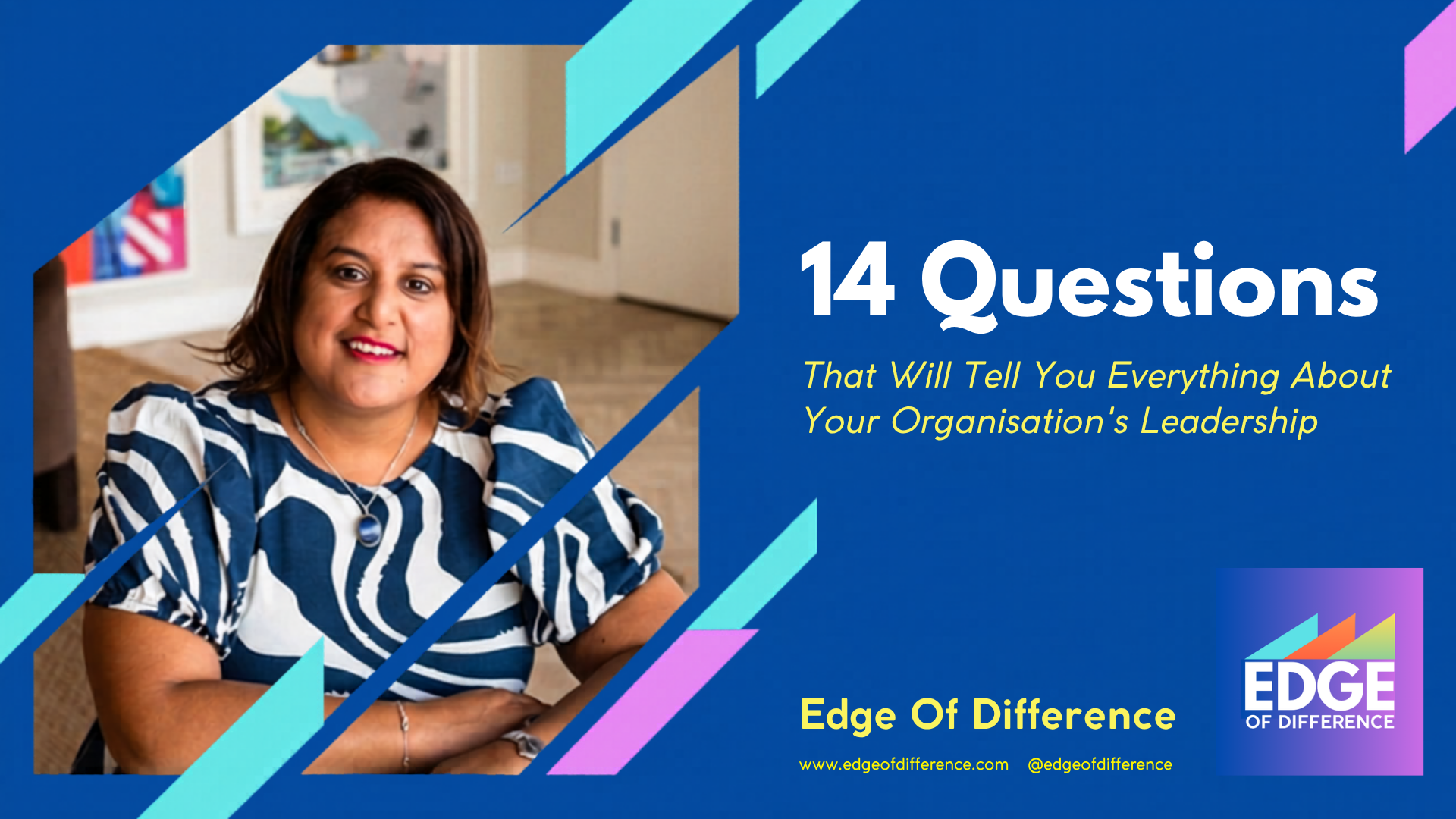
Future talent is not waiting to be discovered. They are watching. And what they see when they ask these questions will determine whether they stay.
There is something that does not often get said in management meetings.
Not because the room lacks intelligence. Not because the people in it do not care. But because the questions that would get to the truth are the ones that feel too direct, too uncomfortable, too pointed to ask of someone with the power to determine your next opportunity.
So we ask the safe questions. The ones that signal engagement without creating risk. The ones that produce an answer without producing accountability.
This piece is not about those questions.
It is about the fourteen questions that actually reveal something. About the culture, the pipeline, the gap between what your organisation says it is doing on inclusion and what is actually happening for the people inside it. About whether leadership is creating the conditions for future talent to stay, grow and lead, or whether it is quietly losing them to organisations that already figured this out.
These questions are drawn from the research behind Future Talent: How Different People Will Be Tomorrow’s Leaders (Trotman, December 2026). They are for anyone who wants to lead better, understand more, or simply stop looking back in five years and wondering where the talent went.
The questions about the pipeline
1. “What does our leadership pipeline actually look like and what assumptions might be shaping who we’re putting in it?”
Most organisations believe their pipeline is meritocratic. Most pipelines are not. The decisions about who gets development, sponsorship, stretch assignments and visibility are shaped by familiarity, comfort and pattern recognition as much as they are by potential. Asking this question out loud is the beginning of understanding the difference.
2. “As Millennials and Gen Z become the majority of our workforce, how are we adapting our leadership culture to match what they value?”
These are not niche demographics. They are the present and near-future of every workforce, and they are demanding something different from leadership: authenticity, values alignment, inclusion that is felt rather than announced. The organisations that are not adapting are not losing the argument. They are losing the people.
3. “Are our leadership development programmes designed for the leaders we’ve always had, or the leaders we need next?”
This is the question that tends to be met with a long pause. Most leadership development is designed, consciously or not, to replicate existing patterns. It rewards a particular style of confidence, a particular mode of ambition, a particular way of being present in a room. If the programme does not challenge those patterns, it is not developing future leaders. It is producing copies.
4. “When we say the pipeline isn’t there yet, are we describing reality or defending inaction?”
The pipeline argument is one of the most well-worn defences in leadership diversity conversations. It is also, in most cases, factually contestable. Future talent exists. It is often outside the informal networks that leadership relies on. The question is not whether it is there. The question is whether your structures are designed to find it.
The questions about voice and power
5. “Whose voices are genuinely shaping our strategy and are there people in this organisation whose perspectives we’re systematically missing?”
Diversity of thought is not produced by having different people in the room if those people are expected to arrive at the same conclusions by the same routes. The question is not only who is present. It is whose perspective is actually changing the direction of the conversation.
6. “How has our thinking on leadership changed in response to wider movements like #MeToo or Black Lives Matter and what concrete shifts have we actually made?”
The gap between an organisation’s public statement on inclusion and its internal reality is one of the most exhausting things for future talent to navigate. This question distinguishes between organisations that responded to these movements with language and organisations that responded with structural change. The difference is visible to everyone inside the building.
7. “Can people in this organisation genuinely disagree with a senior leader, without it costing them something?”
Psychological safety is not a culture value. It is a daily experience. And the honest answer to this question, in most organisations, is: it depends on who you are, who you are disagreeing with, and what the disagreement is about. That conditional answer is worth examining.
8. “Who are the people shaping decisions in this organisation outside formal meetings and is that group as diverse as we say we want to be?”
This is the question about informal power. About who gets included in the conversation before it becomes a meeting. About whose perspective shapes the thinking before anyone is asked to vote. The formal structures of inclusion are easier to change than the informal ones. The informal ones are where the real work is.
The questions about honesty
9. “What’s the most uncomfortable truth someone has told you recently and what did you do with it?”
This question reveals more about a leader than almost any other. Not because discomfort is the goal, but because the willingness to receive uncomfortable information (and to act on it rather than manage it) is one of the clearest indicators of whether a leadership culture is genuinely safe or only performs safety.
10. “When talented people leave, do we honestly examine whether leadership was a factor or do we explain it away as a personal choice?”
Exit data is not neutral. The reasons people give when they leave are shaped by what they believe they can safely say. The reasons they do not give are often the most important ones. The organisations that are genuinely learning from attrition are the ones willing to go further than the leaver survey.
11. “Are we mentoring diverse talent or actually sponsoring them and do we know the difference in how we’re using both?”
Mentoring and sponsorship are not interchangeable. Mentoring is valuable and costs relatively little. Sponsorship is the act of using your own credibility and visibility to open doors for someone else, naming names in rooms with power, advocating when the person is not present. The organisations that conflate the two tend to have lots of mentoring relationships and very little movement in the pipeline.
The questions about the future
12. “How do we make sure our stated values are visible in day-to-day leadership behaviour, not just on a wall or in a deck?”
Values that exist only as language are not values. They are aspirations. The test of a leadership culture is not what it writes in the annual report. It is what happens in the difficult moments, the ones nobody planned for, when the choice between comfort and integrity becomes clear.
13. “If tomorrow’s leaders already look different from today’s, are we genuinely ready to follow them?”
This is the question at the centre of Future Talent. Because the argument is not only about creating conditions for diverse talent to reach the top of existing structures. It is about whether those structures are themselves ready to be led differently. Whether today’s leaders can follow as well as they lead. Whether power, when it shifts, will be handed over or held on to.
14. “What will the next generation of leaders in this organisation say you made possible for them?”
This is the question about legacy. Not the legacy of a career or a tenure. The legacy of a leadership approach. Whether the people who came after you had more room to lead authentically than you did, or whether the ceiling stayed where you found it.
Why these questions matter now
Future talent is not sitting quietly, waiting to be discovered by leaders who are ready for them.
They are watching. They are drawing conclusions, and are making decisions about which organisations are worth their commitment and which ones are performing inclusion while practising something else entirely.
The research is unambiguous: Millennials and Gen Z will make up the majority of the global workforce within years, not decades. They are not outliers. They are the mainstream. And they are demanding leadership cultures that reflect what they know inclusion can actually be: structural, honest, and felt in the daily experience of working here rather than announced from the front of a room.
The organisations that will attract and retain them are not the ones with the best inclusion policies. They are the ones where these questions get asked, get honest answers, and actually change something.
The questions are not the hard part. The willingness to hear the answers is.
Future Talent: How Different People Will Be Tomorrow’s Leaders by Mo Kanjilal Williams is published by Trotman in December 2026. Pre-order your copy now.
At Edge of Difference, we work with organisations ready to close the gap between the culture they believe they have and the one their people are actually experiencing. If this piece landed somewhere real for you, let’s talk and take action.