
Employee benefits, or perks, attract and retain talent. In addition, they improve wellbeing, and encourage shared values, celebrate achievements, and foster key skills. Introducing, enhancing and evaluating benefits for workers enables us to support people management practices that aligns with wider business goals.
Employee benefits do far more than just a wellbeing package – they reshape workplace experiences.
We researched the current benefits workplaces are offering employees. Then, we asked our community what employee benefits matter to them. If you want to know why employee benefits matter so much, you’re in the right place. Read on to learn what are the most common benefits, what this means to your workers, and how robust benefits influence a competitive advantage among employers.
The impact of employee benefits
According to Aptia, this is how benefits enhance multiple employee and employer workplace dynamics:
#1: Benefits provide financial security: Health benefits shield employees from high medical costs, retirement plans build long-term savings, and life insurance protects families from sudden loss of income.
#2: They boost retention and create deeper job satisfaction: Employee benefits like paid time off and retirement plans top the list of must-have perks. A robust benefits package shows you’re invested in employees’ futures, encouraging them to invest their future with you.
#3: Benefits supercharge workplace enthusiasm and productivity: Access to wellness programs, flexible work arrangements and employee assistance programs actively reduce stress and employee absenteeism.
#4: Work-life balance is another powerful outcome: Paid leave, hybrid schedules and fringe benefits such as childcare support employee morale and give staff the flexibility to manage personal responsibilities without sacrificing career growth.
#5: The right benefits enhance well-being: When it comes to comprehensive benefits, think mental health coverage, on-site fitness or digital wellness apps — all of these address physical, emotional and social needs.
#6: Amplified employee loyalty: When employees feel cared for, they respond with commitment to company goals, stronger teamwork and a willingness to champion your brand.
#7: A robust benefits package attracts top talent: Job seekers increasingly weigh benefits alongside salary and company culture, so a comprehensive employee benefits package can be the deciding factor for high-performing candidates.
#8: Lowering employee turnover: Replacing a full-time employee can cost up to twice the individual’s salary, so retaining talent through good benefits strengthens the bottom line.
#9: Gaining a competitive edge: Superior packages differentiate your brand, making it easier to win bids, secure contracts and outpace rivals that treat benefits as an afterthought.
#10: Building a positive industry reputation: Word of mouth travels quickly, so companies known for caring benefits become employers of choice and thought leaders in human resource management.
There are some mandatory benefits. Certainly, to remain compliant and safeguard your reputation, you must provide certain mandatory benefits. Below is a concise overview of the essentials you’ll likely need to cover for eligible employees — depending on industry, company type, company size and state-specific requirements:
- Social Security
- Medicare contributions and health coverage
- Retirement
- Unemployment insurance
- Workers’ compensation
- Family protections
Further, meeting these obligations not only avoids costly penalties. It demonstrates that your organisation values legal compliance and the basic welfare of its workforce
Voluntary benefits elevate your package from basic or acceptable to exceptional. Therefore, consider the following high-impact options:
- Paid time off
- Education incentives
- Professional development assistance
- Life insurance
- Vision care
- Dental insurance
Altogether, selective, thoughtful voluntary perks demonstrate genuine care for employee needs, leading to stronger engagement and lower turnover. With the building blocks defined, the next step is mastering best practices for crafting, communicating and future-proofing your benefits strategy for sustained employee satisfaction.
What our community thinks
Our community affirms that benefits aren’t just a “nice to have”.
These are opportunities to celebrate employees, craft a culture of belonging and retain talent. What the future of employee benefits holds is not about workplace “perks”. It is about tangible, meaningful and visible support.
Moreover, when you embed benefits, you are actively showcasing to the workforce the value of your employees.
Out of the top common benefits we researched, here is what our community has said about which benefits matter most to employees:
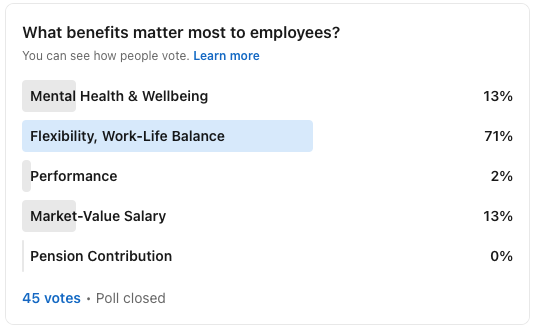
As anticipated, our community commented on how workplace essentials are reframed as “benefits”. To quote Julie Kasinski:
“Thanks for opening up this discussion, it is so needed. But calling a market‑value salary a “benefit” feels wild to me. It is the foundation of employment (or at least it should), not an add‑on. And honestly, a few items on that list fall into the same category: they are essentials. And if they are not considered as such, it is a sad reminder of how low the bar is.”
Rippl’s latest research reveals over nearly half of UK employers disguise employees’ statutory rights as workplace perks, coined as the ‘bare minimum benefits.
Additionally, their analysis of UK job ads reveals how UK employers are touting statutory requirements or basic amenities as significant workplace benefits. Rippl’s research scoured the UK’s largest job listing sites and found that 46% of current vacancies list a statutory right as an employee benefit.
Here’s what Rippl found:
‘Company pension’ (present in a staggering 124,589 current job ads), ‘20 days holiday’ (mentioned in just over 2,000 ads), and ‘statutory sick pay’ (253 mentions) are legal obligations, yet companies are flaunting these as significant reasons to join their business. Likewise, the same goes for free parking (over 66,000 mentions) or ‘on-site parking’ (mentioned over 95,000 times) which are often expected workplace features, particularly in suburban areas.
Their findings also found that many employers are promoting necessities and underwhelming treats as benefits.
Also, free tea topped the list with 1,078 mentions, something most would expect as a basic courtesy, not a perk. This was followed by the stereotypical offering of ‘free fruit’ (675 mentions) and one position even listed ‘free water’ as a benefit.
Other listed enticements include free pizza (126 mentions), raffles (435 mentions), and beanbag chairs (3 mentions).
Bare minimums (e.g., SSP, statutory leave, pensions) are legal obligations, while true benefits include flexible working, health insurance, and wellbeing support. Offering only basic perks like free fruit or coffee is often seen as “bare minimum” and fails to boost engagement.
Mandatory “Bare Minimum” Benefits (UK)
- Workplace Pension: Employer must provide auto-enrolment with minimum contributions.
- Statutory Sick Pay (SSP): Currently £118.75/week for up to 28 weeks.
- Statutory Annual Leave: Mandatory paid time off.
- Maternity/Paternity Pay: Statutory payments required by law.
Examples of True Benefits (Retaining Staff)
- Flexible Working: Working from home and flexible hours.
- Private Health Insurance: Covering pre-existing/chronic conditions.
- Enhanced Benefits: Increased pension contributions, additional paid time off, and wellbeing support.
“Bare Minimum” Perks vs. True Benefits
- Bare Minimum Perks: Free coffee, fruit, and snacks are “basic courtesy” or, as shown in this Rippl blog post. A way to disguise a lack of real benefits.
- What Employees Value: Workers prioritise flexible working, job security, and strong company culture over free food.
Conclusion:
Employee benefits often distinguish between mandatory, legal requirements (the “bare minimum”) and voluntary perks aimed at retention.
Employers only providing mandatory benefits,as noted on the Zhoosh Benefits website , may struggle with retention. Noted in this Reddit discussion , face high turnover.
Employee benefits are not just “extras” – they make their employees feel valued. However, success is hindered when they are underused or uninspiring.
As employers, you need to provide the benefits people actually want.
At Edge Of Difference, we help organisations, especially within leadership, step into embodying the employer employees want to work for. To co-create an inclusive culture, setting your Diversity, Equity and Inclusion goals up for success.
Download our free checklist and action plan on Employee Benefits to get started! Turn those differences into action by booking a call with us today.